
Tips for buying a school backpack
The first school backpack is more than just a backpack – it's the defining companion for a new chapter in the life of your six-year-old child. When families start to look for Tips for buying a school backpack When looking, they inevitably face a well-known conflict. Children are excited by bright colors and exciting motifs, while parents must ensure that the design actually supports the growing body. Thus, the search for a ergonomic school bag for first graders to a sensitive balance between visual aesthetics and strict medical necessity.
Your child will wear this important equipment about 180 days a year, often loaded with heavy workbooks and a full water bottle. According to pediatric orthopedic guidelines, a bag that does not properly distribute weight across the stable pelvic bones leads to 180 days of unnecessary physical strain on the delicate shoulder muscles and developing spine.
When viewing this purchase as an investment in an important health tool rather than a mere accessory, it changes how we navigate the brand jungle. In practice, evaluating features like ergonomic back shape and structural safety ensures that the daily trip to the school bus promotes independence rather than causing discomfort.
Timing is everything: When to find the best selection and lowest prices when buying a school backpack
The question „When should you buy a school backpack?“ often occupies families a full year before school enrollment. While you may already have a firm budget in mind, the school bag market goes through a strict seasonal cycle. This rhythm ultimately determines whether your child gets their absolute favorite design or if you save the household budget.
Basically, you have the choice between maximum variety and the best price:
- January to March In this phase, new collections appear. The selection of designs and back-friendly models is huge, but notable discounts are rare.
- June to July (School Backpack Sale): Just before school starts, retailers are clearing out their stock. You can save up to 40 percent here, but you often have to compromise on color and design.
However, waiting too long carries a physical risk. When the shelves are cleared in late summer, you'll find discounted remaining stock, but often not the exact model that optimally fits your child's individual spine. No matter how you decide on the topic of When to buy a school backpack Fails: Fit always remains the most important criterion.
Ergonomics Check in 5 Minutes: How to Tell if the Schoolbag Really Fits
A child's back grows rapidly and its proportions constantly change. This is precisely the biggest challenge during fitting: the backpack must adapt to the body, not the other way around. If the weight swings wildly while walking, painful tension is a risk. The following provides reliable guidance here: AGR Seal of Approval for Back-Friendly School Backpacks (Aktion Gesunder Rücken), which identifies models that can be individually and ergonomically adjusted.
View your child's spine from the side: it forms a gentle „S.“ The back padding, especially the so-called lumbar support in the lower area, must fit this S-curve precisely without any gaps. Targeted Backpack Brand Comparison for Slim Children This is essential here. With very delicate shoulders, straps that are too wide slip off easily; additionally, the bag must not extend beyond the body at the sides.
Use this simple four-step checklist in your business to Adjusting the backpack to the correct size to be able to
- Shoulder height The top edge of the bag sits flush with the shoulder line.
- S-curve The back cushion lies flat against the lumbar spine.
- Hip belt It rests on the stable pelvic bones and takes over - like a hiking backpack - 50 to 70 percent of the weight.
- Chest strap It holds the straps securely together, even over thick winter jackets.
Only if Chest strap and hip belt for back relief is consistently closed in everyday life, this physical weight shift works. A perfectly fitting backpack therefore protects posture in the long term. But what's the use of the best carrying comfort if your child is overlooked on the way to school in the morning?

Safety through visibility: Why reflectors alone are not enough in winter
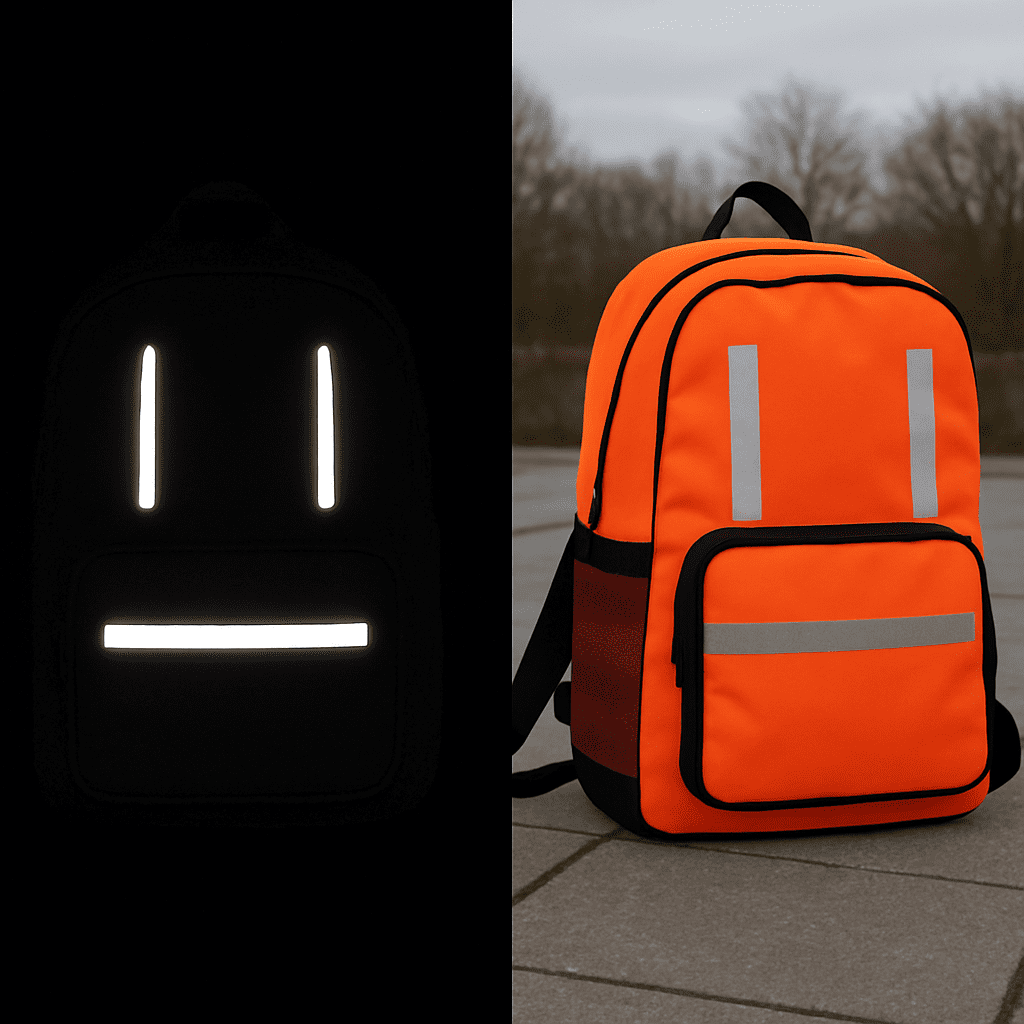
In autumn and winter, the morning walk to school often resembles a trek through twilight. Many parents rely on silver luminous stripes, but these so-called retroreflective materials only reflect light when directly illuminated by car headlights in the dark. On a gloomy, rainy afternoon, they offer little protection. This is exactly where fluorescent fabric in neon orange or neon yellow comes into play, bundling sparse daylight and shining brightly even on gray days.
To guarantee this vital visibility, there is reliable guidance: A School backpacks with reflectors according to DIN 58124 meets the strictest German safety requirements. Look for this seal, as it requires precise division to protect your child:
- Daylight fluorescent color At least 20 percent of the surfaces must be made of fluorescent material to be visible during the day.
- Night reflectors At least 10 percent must be retroreflective to reflect headlight beams at night.
When the bag lights up from 100 meters away, drivers gain valuable seconds to react. However, a sturdy outer shell is only half the battle for a carefree school day. To prevent your child from losing balance due to one-sided strain, proper internal distribution is equally crucial.
Order brings lightness: How to distribute weight optimally and protect your back
The maximum weight of a filled school backpack often causes uncertainty, as a strict ten-percent rule was in place for a long time. However, orthopedists today emphasize that individual physical development and a perfect fit are much more crucial than a rigid number on the scale. An ergonomically well-adjusted backpack that dynamically shifts the weight onto the stable hip bones makes even a well-filled bag appear noticeably lighter for your child.
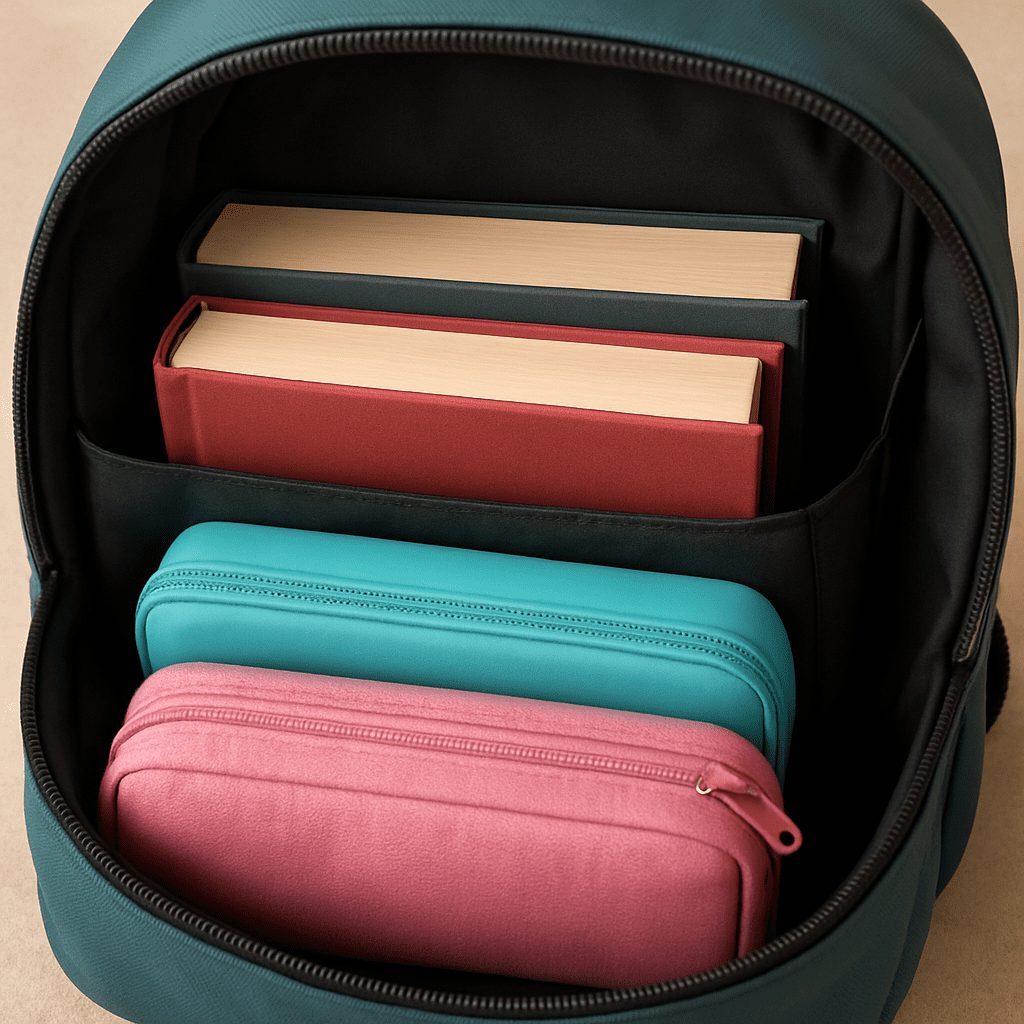
For this weight shift to work in everyday life, you need to consider the law of leverage in physics when packing. Heavy items such as thick books or water bottles should always be placed in the inner compartment that lies directly against the back padding. If this weight slides into the front part of the bag instead, a strong lever effect is created, which inevitably pulls your child backward, forcing their delicate spine into an unhealthy lordotic posture. Lighter items like a pencil case, on the other hand, are ideally placed at the very front.
Hidden burdens sneak in quickly, however, as crumpled worksheets, collected stones, or notebooks that are not currently needed accumulate over the weeks. Therefore, a joint, weekly decluttering is the most effective way to permanently relieve the back.
Price-Performance Check: How much a good school backpack should cost and which accessories are useful
When buying a school backpack, the crucial question quickly arises: How much does a good school backpack actually cost? For a high-quality, back-friendly model, you should budget between 200 and 300 euros. At first glance, this sum seems high, but let's break it down: With around 180 school days over four years of primary school, the cost per use drops to just about 35 cents a day.
Financially, it usually pays off to opt for coordinated complete packages. A reliable school backpack set content recommendation includes the following essential companions:
- Fully equipped pencil case
- Pencil case for crafting scissors and glue stick
- Gym bag or sports bag
- Integrated, custom-fit rain cover
In addition to price, the origin of textiles is increasingly coming to the attention of parents. Sustainable school backpacks made from recycled materials use empty PET bottles, which are melted down and spun into extremely resistant textile yarn. This not only conserves resources but also provides your child with an absolutely tear-resistant, water-repellent fabric.
Longevity and Care: How a School Backpack Can Last Through All of Elementary School
After countless playground adventures and puddle jumps, backpacks often look worn. Even though the temptation in busy family life is great, never put it in the washing machine. The violent spin cycle will destroy the supporting back panel and the internal frame, which are absolutely essential for your child's healthy posture.
For a gentle hand wash, this simple backpack cleaning and waterproofing guide will help instead:
- Brush or vacuum off heavy dirt from the inside and outside when dry.
- Gently dab the stains with lukewarm water, a little dish soap, and a soft sponge.
- Treat the completely dried fabric annually with a waterproofing spray to refresh the water-repellent protective layer.
Also be sure to keep the warranty card to be directly covered in case of frame breaks or sticking magnetic clasps. With the right care, the model will easily last the entire four years of elementary school.
Your Guide to Success: The Ultimate Checklist for Buying a School Backpack
From the initial jungle of colorful motifs, you've now found a clear path to actively protect your child's health. You now know exactly what's important for trying on school bags for a healthy back. Take this compact checklist with you directly to the specialist store:
- Secure the pelvic strap first and firmly on the stable hip bone.
- Check that the top edge of the backpack is flush with the shoulder line.
- Be sure to have your child test the model with a thick winter jacket.
- Ensure that the empty backpack stands upright and is stable on its own.
- Check if your child can open the closure easily with one hand.
Ultimately, even the best ergonomics are only useful if the backpack is gladly worn. Celebrate this purchase as an exciting milestone! If your child walks through the store proudly and without complaining, you have found the perfect companion for starting school.