
It's a moment almost all mothers and fathers know: their own child does something seemingly extraordinary. They say their first word earlier than the neighbor's child, solve a puzzle for three-year-olds at age two, or effortlessly memorize all the dinosaur species with their Latin names. Immediately, a thought shoots through their mind: Is my child perhaps a genius?
The truth is often much more mundane. Many parents mistakenly believe their child is gifted., because they mistake normal developmental spurts, minor talents, or simply a strong interest in a particular subject for genuine intellectual giftedness.
In this comprehensive guide, we take a detailed look at the reality of child development. We clarify how you truly Signs of genuine giftedness, which psychological mechanisms at play for parents and how you your child can optimally support, without overtaxing it.

1. Why Parents Are So Often Wrong: The Psychology of Perception
It is in our nature to view our offspring as something very special. This makes evolutionary sense, as this unconditional love ensures survival. However, when it comes to objectively assessing cognitive abilities, our feelings often get in the way.
Parents' Perception of Children's Abilities
The Perception of children's abilities by parents is highly subjective. We usually see our children in isolation or in direct comparison with only a few other children (e.g., in playgroup). When our own child suddenly makes a leap forward in a certain area, it seems like a miracle to us. The fact that other children are making similar leaps in other areas (such as motor skills or social behavior) at the same time is often overlooked.
Parental projection of one's own desires
Another, often unconscious, factor is the Parental projection of one's own desires. In a meritocracy, intelligence is equated with later success, wealth, and happiness. Some parents project their own, perhaps unfulfilled, academic or professional dreams onto their child. The desire to have a „special“ child can become so strong that completely normal behavior is reinterpreted as a sign of genius. A child who enjoys looking at books is then quickly styled as a future Nobel laureate in literature.
2. What does giftedness really mean?
To understand the phenomenon, we must move away from the emotional level and look at the scientific facts. Giftedness is not a diffuse concept but is clearly defined in psychology.
The Hard Limit: An IQ of 130
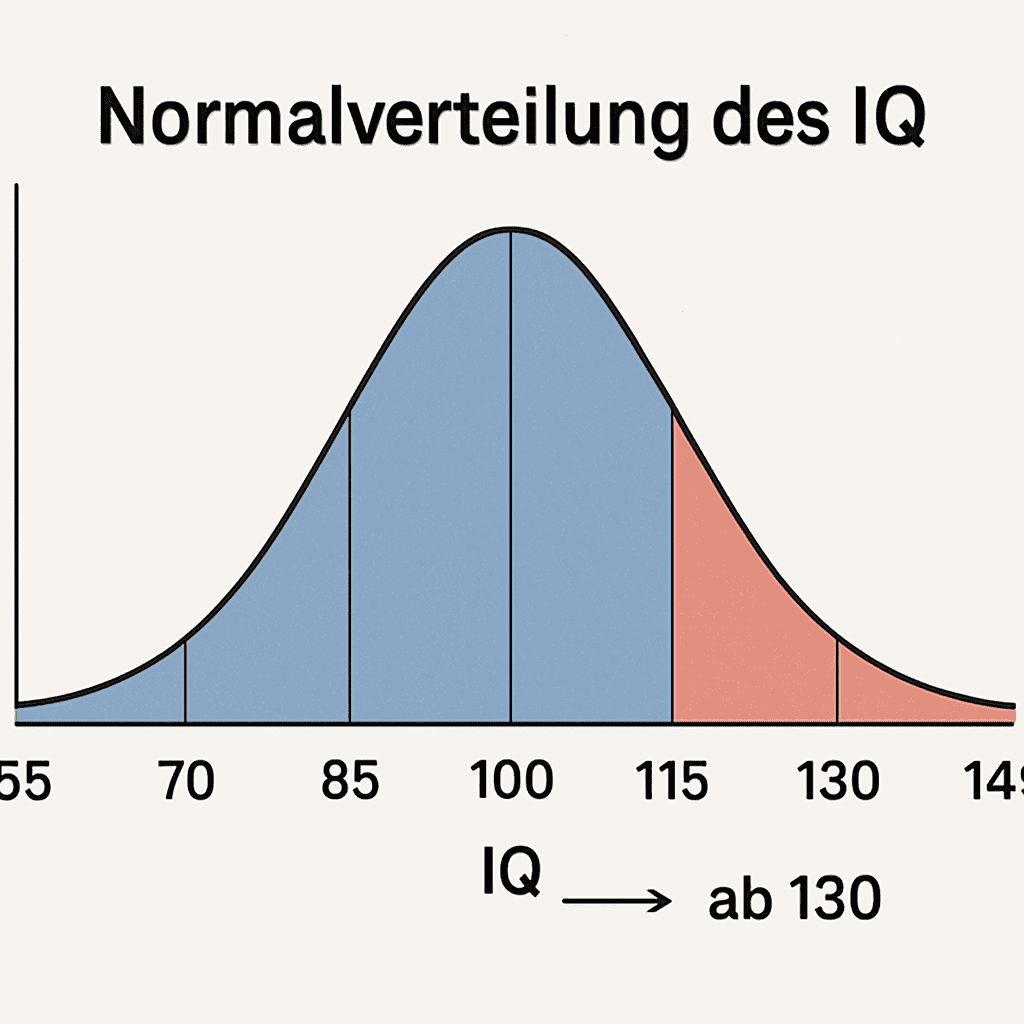
Intellectual giftedness is generally spoken of when a person achieves an intelligence quotient (IQ) of 130 or higher in a standardized intelligence test. Intelligence in the population is normally distributed (the so-called Gaussian bell curve). The average is 100.
- About 68% of people have an IQ between 85 and 115.
- Only about 2.2% of the population scores 130 or higher and is therefore considered gifted.
Characteristics of above-average intelligence
When we talk about giftedness, it's not about a child being able to memorize well. Characteristics of above-average intelligence rather show themselves in Manner, how the brain processes information. This includes:
- An extremely high comprehension ability.
- The ability to quickly recognize complex relationships and patterns.
- Interconnected thinking across different subject areas.
- Exceptional logical and abstract reasoning skills.
3. Myths about gifted children: What Hollywood teaches us incorrectly
A major reason why many parents mistakenly believe their child is gifted is due to the false images that media and movies present to us. Countless Myths about gifted children, which urgently need to be investigated.
- Myth 1: Gifted children are always little Einsteins and top students.Fact: Many gifted students are so-called „underachievers.“ They get so bored in class that they tune out, refuse to do homework, or even get bad grades.
- Myth 2: Gifted children learn everything on their own.Fact: Even a highly gifted brain needs stimulation, techniques, and sometimes even tutoring in areas like organization, frustration tolerance, or social interaction.
- Myth 3: They are always socially isolated and „nerds.“.Fact: Most gifted children are very well socially integrated. It only becomes noticeable when they can't find like-minded peers, as their interests are often not age-appropriate.
- Myth 4: Early readers are always gifted.Fact: Teaching yourself to read at age four is a strong indicator, but not proof. There are children with average IQs who read extremely early (hyperlexia), and gifted children who only learn to read in school.
4. The Difference Between Developmental Advantage and Giftedness
This is arguably the most important point for parents of toddlers and preschoolers. Child development does not proceed linearly, but in leaps.
When children are ahead of their time
An developmental advantage means a child reaches certain milestones significantly earlier than average. They speak in full sentences when others are still using two-word phrases. They can do math within ten before starting school.
The serious Developmental advantage and giftedness However, it lies in the long-term perspective. An advance in development is almost always compensated for during childhood (mostly by the end of primary school, around 8 or 9 years of age). The other children simply catch up. True giftedness, on the other hand, is a constant state of cognitive ability that lasts a lifetime.
Early Childhood Development Milestones Overview
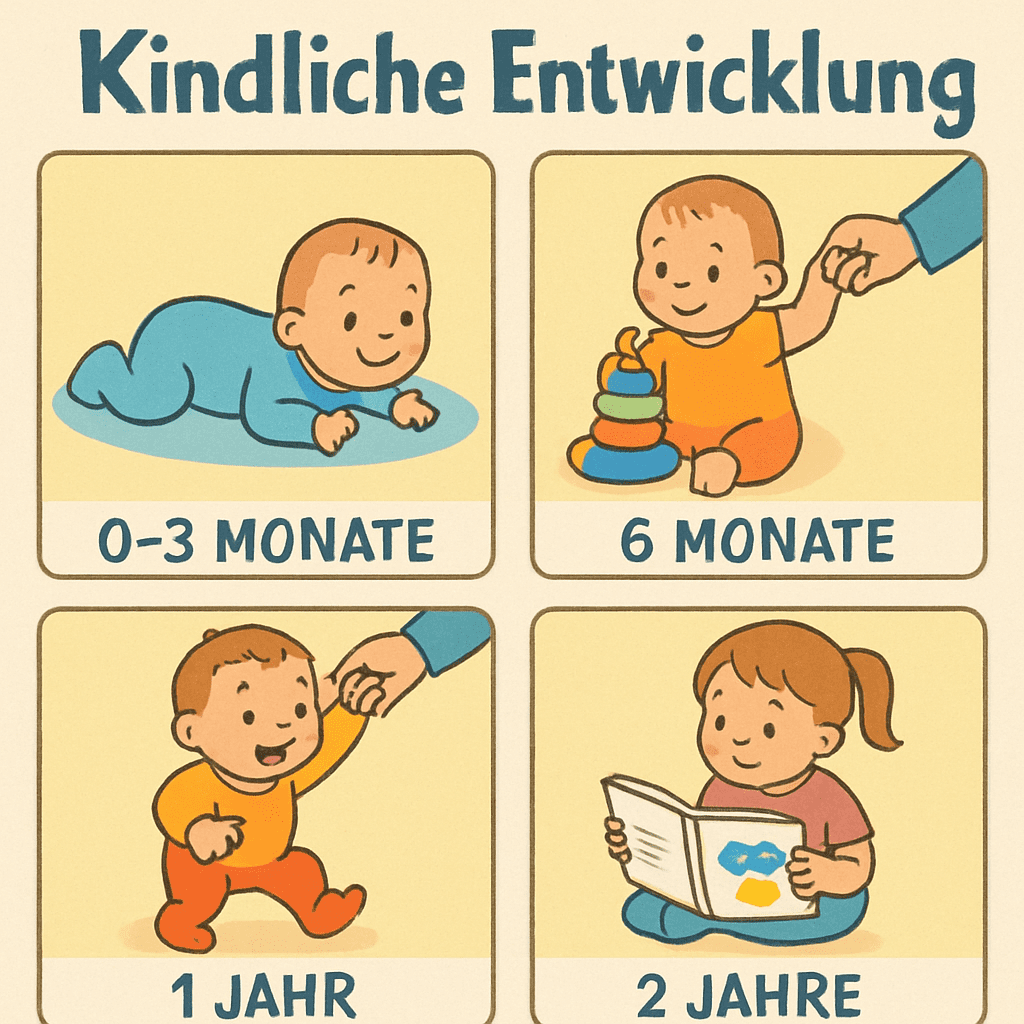
To better understand your child's behavior, a short Early Childhood Development Milestones Overview (Averages):
- 12-18 months: First steps, approximately 5 to 20 words.
- 2 years Two to three-word sentences, climbing stairs while holding on.
- 3 years Asks „why,“ speaks in simple grammatical sentences, builds towers of 8-10 blocks.
- 4-5 years: Uses complex sentences (past, future), draws stick figures, begins to be interested in letters or numbers, role-playing.
If your child reaches these milestones a little earlier, that's wonderful. It's a sign of healthy, fit development – but it's by no means a guarantee of the top IQ percentile.
5. Giftedness vs. Talent: An Important Distinction
The terms gift and talent are often used synonymously, but in educational psychology, there are subtle differences. A Giftedness vs. Talent Comparison helps to correctly interpret the child's abilities.
Talent A talent generally refers to a specific area. A child can have outstanding musical talent, play an instrument virtuously, and possess perfect pitch. Or they can be exceptionally talented in sports. Talent can also be cognitive, such as an extreme gift for drawing or languages. However, a gifted child's general IQ can be completely average.
Giftedness Giftedness is a Potential. It is the general, cross-disciplinary ability to absorb, process, and combine information extremely quickly. A gifted child does not necessarily have to play an instrument or paint great pictures. Their talent often manifests in a penetrating way of thinking, high problem-solving skills, and enormous cognitive flexibility.
In summary: Every gifted child has the potential to develop talents. However, not every highly talented child is generally intellectually gifted.
6. How to Really Recognize Gifted Children
If early talking or puzzles alone aren't enough, what should parents pay attention to? recognizing giftedness, one must observe more profoundly. Gifted children fall through a combination of specific personality and behavioral traits.
Signs of genuine giftedness
The following points are indicators that, when they appear together, may point to exceptional cognitive abilities:
- Extreme obsessiveness with detail and observation skills The child notices changes in their environment that adults miss (e.g., „The car that was standing there yesterday had a different license plate“).
- Comprehensive, unusual vocabulary: The child uses words early on that they shouldn't really have understood yet, but applies them absolutely correctly in context.
- Profound existential questions: Even at the age of 3 or 4 years, these children think deeply about death, the universe, the meaning of life, God, or justice.
- Strong sense of justice They react extremely sensitively when they feel that rules are being applied unfairly, not just to themselves but also to others.
- Preference for older children or adults: As they often feel cognitively underchallenged by their peers, they seek contact with older people in order to have conversations „on their level.“.
- Rapid learning speed If they are interested in a topic (e.g., outer space), they soak up information like a sponge and quickly become little experts.
- Perfectionism They set their own standards very high. This can lead to them refusing things („I'm not drawing anymore!“) because the result on paper doesn't match the perfect image in their head.
It is important to emphasize: No child shows all these features simultaneously.

7. The Path to Certainty: Diagnostics and IQ Tests
When parents notice that their child is massively deviating from the norm and perhaps even suffering because of it, the question quickly arises: should we get them tested?
An IQ test for children can be useful when: * **There are concerns about learning difficulties:** If a child is struggling in school, experiencing academic challenges, or showing signs of developmental delays. * **Identifying giftedness:** For children who are exceptionally bright and may benefit from enriched or accelerated educational programs. * **Diagnosing learning disabilities:** To help understand and diagnose conditions like dyslexia, dysgraphia, or dyscalculia, and to guide appropriate interventions. * **Assessing cognitive strengths and weaknesses:** To gain a comprehensive understanding of a child's intellectual profile, which can inform educational strategies and support. * **Understanding developmental delays:** In cases where there are concerns about a child's overall development and cognitive functioning. * **Before making significant educational decisions:** Such as placing a child in a special education program or an advanced placement class. * **As part of a broader psychological evaluation:** When a child is experiencing behavioral or emotional issues, understanding their cognitive abilities can provide valuable context.
An intelligence test should never be conducted out of pure curiosity or parental vanity („I need a certificate for my brilliant child“). When is an IQ test useful for children?The clear answer of most psychologists is: If there is pressure to suffer or a concrete decision problem.
Reasons for a test can be:
- The child is extremely frustrated, aggressive, or completely withdrawn at kindergarten (possible bore-out due to underachievement).
- Academic decisions are pending, such as early school enrollment or skipping a grade.
- The child underachieves at school, even though they are obviously smart.
- There is suspicion of misdiagnoses such as ADHD, although the child's restlessness is actually due to chronic boredom.
Giftedness assessment by a psychologist
The Giftedness assessment by a psychologist is a professional process. A reputable diagnostician will not just go through a test sheet, but will first conduct a detailed anamnesis interview with the parents (and often teachers or educators). They observe the child's behavior during the test: How do they handle frustration? How quickly do they give up? How concentrated are they working?
Psychological Tests for Determining Intelligence
There are various standardized Psychological Tests for Determining Intelligence, which are used depending on age. Well-known methods in German-speaking countries include, for example, the WISC-V (Wechsler Intelligence Scale for Children) for school-aged children or the WPPSI-IV for preschoolers.
These tests measure different dimensions of intelligence, including:
- Language comprehension
- Visuospatial thinking
- Fluid reasoning (logical reasoning without prior knowledge)
- Working memory
- Processing speed
Important Age Notice: Testing in children under 5 years old is not very informative. Development is so rapid at this age that an IQ measured today can be completely different in two years. Ideally, testing should be done starting at elementary school age.
8. The flip side: When desire becomes a burden
Let's get back to the original problem: Many parents mistakenly believe their child is gifted. This often has consequences for the child's psyche.
Consequences of excessive expectation pressure
When parents are firmly convinced they have a little genius at home, they often unconsciously change their behavior. They primarily praise the child for its intelligence, enroll it in countless courses (Mandarin for toddlers, cello lessons, chess club), and signal to them: „You are special, so we expect special things.“
The Consequences of excessive expectation pressure can be devastating for a child, regardless of whether they are truly gifted or not:
- Loss of intrinsic motivation The child no longer learns because they enjoy it, but to fulfill their parents' expectations.
- Extreme fear of failure When the self-image („I am the smartest“) is shaken, for example by a first bad grade in elementary school, a world collapses for the child.
- Psychosomatic complaints Stomachaches, headaches, or sleep disturbances are classic symptoms for children under constant pressure.
- Robbing Childhood: Children need time for free, unstructured play. If a five-year-old's schedule looks like that of a top executive, there's no time for dreaming, roughhousing, or „simply being a child.“.
It is a bitter irony: out of great love and the desire to open all doors for their child, parents sometimes build a golden cage that psychically crushes the child.

9. Encouragement Without Overwhelm: How Parents Can Respond Correctly
Whether your child has an IQ of 100, 115, or 135 – the goal of parental upbringing should always be a happy, resilient, and mentally healthy child.
Support the child's cognitive development in an age-appropriate manner
The best strategy is to Support the child's cognitive development in an age-appropriate manner, to orient oneself to the child's interests and the so-called Pacing (the speed) to the child. If they want to know all about volcanoes today, go to the library and get appropriate books. If they prefer to play in the mud for three hours tomorrow, that's just as valuable for their neural development.
Tips for everyday life:
- Praise the effort, not the intelligence Instead of saying „You're so smart!“, say „I'm proud of how hard you worked on this difficult puzzle and didn't give up.“ This promotes a „growth mindset.“.
- Answer questions honestly: If you don't know the answer to one of your child's profound questions, say, „I don't know. Let's find out together!“
- Provide compensation: Cognitive abilities are great, but the body needs to move too. Sports, playground climbing, and crafting are equally important stimuli for the brain.
Gifted Education and Support for Highly Gifted Individuals: Prerequisites
If giftedness has indeed been identified, the question arises about special gifted education. There are roughly two ways to go about this:
- Acceleration: Early admission, skipping a grade, or early commencement of studies.
- Enrichment Additional offerings that go into depth. For example, after-school researcher clubs, learning a rare language, or special competitions („Jugend forscht“).
The Gifted education requirements However, they must always be reviewed individually. Especially when skipping a grade, intellect should not be the only factor considered. The child must also be emotionally, socially, and physically mature enough to cope with older classmates.
10. Where Families Can Find Help and Advice
If you are unsure how to assess your child, or if things are not going well at school or in kindergarten, you don't have to go through it alone.
Parental counseling for suspected giftedness
A competent Parental counseling for suspected giftedness is gold when it comes to overcoming your own tunnel vision. There are various points of contact:
- School Psychological Service / Educational Counseling Centers These are mostly free and connected to the municipalities. They can be the first point of contact when school-related or family conflicts are at the forefront.
- The DGhK (German Association for Gifted Children): This is a large, non-profit association that offers volunteer counseling, parent groups, and playgroups for children. Here, parents meet like-minded people, which often has a very relieving effect.
- Specialized child and adolescent psychologists: Anyone seeking comprehensive diagnostics should turn to psychologists specializing in giftedness assessment.
These experts can objectively assess whether the child's thirst for knowledge warrants specific enrichment programs or if they are simply a bright, happy child with a temporary developmental lead.
11. Conclusion: Every Child is a Miracle – IQ Regardless
It is psychologically absolutely understandable that many parents mistakenly believe their child is gifted. It stems from the deep love for their own child and the justified pride in every new step towards independence.
However, fixating on a label like „giftedness“ carries dangers. It can lead to unnecessary pressure, parental disappointment, and overwhelming the child. It is essentially important to know the difference between a rapid developmental advantage, a specific talent, and genuine, diagnosed giftedness.
If you feel your child is exceptionally intelligent: Rejoice! Stimulate them, answer their questions, and guide them lovingly. But let the child set the pace. An IQ test is only necessary if the child is suffering or if important school decisions are pending.
Never forget at the end: A person's worth cannot be measured by an IQ. Empathy, humor, creativity, helpfulness, and emotional resilience are often more crucial for a fulfilling, successful life than the brain's pure processing power. A child does not need to be gifted to achieve great things and, above all, to be loved.