
„I'll do it allllll by myself!“ – A sentence that makes many parents break out in a sweat, especially when the clock is relentlessly ticking towards 7:45 AM. Shoes are put on the wrong way for the tenth time, the jacket zipper is stuck, and suddenly the stuffed animal needs a lengthy farewell. You're under pressure, because the meeting at the office won't wait.
We all know that moment. Often we desperately ask ourselves: Why does my child dawdle in the mornings? The answer is simple, but often hard to swallow in everyday life: a toddler's sense of time practically doesn't exist, but their urge for independence does, all the more so. It's the classic conflict between family obligations and child development. However, there are solutions for exactly these heated everyday moments. In this article, we explore 3 Strategies When Toddler Autonomy Clashes With Parent Schedules, so that you can get through your day more relaxed and punctual in the future.

Understanding the Autonomy Phase: A Milestone, Not a Power Struggle
Before we move on to practical strategies, a brief look at the Toddler Development essenziell. Was im Volksmund oft als „Trotzphase“ abgetan wird, ist in Wahrheit eine hochkomplexe und wichtige Phase der Gehirnentwicklung. Die Toddler autonomy is not a personal attack on your already tight schedule. Your child discovers their own will at this age (usually between the ages of 2 and 4) and realizes: I am an independent person who can make things happen.
This urge to do everything yourself is the most important driver for later Strengthen self-confidence possible. If we view childish behavior not as a provocation, but as a biological growth step, one finds Need-oriented parenting in everyday life significantly easier. But how do we reconcile this knowledge with the relentless ticking clock in the workplace?
Here are the three most effective ways.
Strategy 1: Create time buffers and master transitions playfully
The best remedy for stress is preparation. Good Time management for working parents with toddlers means not to structure the day militarily, but to incorporate smart buffer zones for the child's autonomy.
The preparation begins the evening before
A Structured evening routine for relaxed mornings is the key. If you have to think in the morning about what clothes are weather-resistant or what belongs in the lunchbox, you lose valuable time that you actually need for your child's autonomy struggles.
- Lay out clothes: Choose the clothes for the next day together the evening before.
- Pack your bags Your backpack for daycare and your work bag are ready in the hallway.
- Set the breakfast table Set out the plates and cups the evening before.
Whoever invests 15 minutes in the evening can Avoid morning stress with toddlers and has exactly those 15 minutes in the morning that the child needs to put on their socks „awwwll by themselves.“.
Gentle transitions between activities
Toddlers live extremely in the here and now. When they play, that is the most important work in the world for them. An abrupt interruption („We have to go right now!“) inevitably leads to tears. It is important to, Making transitions smooth in everyday toddler life to be able.
- Give advance warnings: „When the alarm clock rings, we'll finish building the tower and then put on our shoes.“
- Use transition objects: Can the toy car jump into the car? Often, it helps to integrate part of the current activity into the next step.
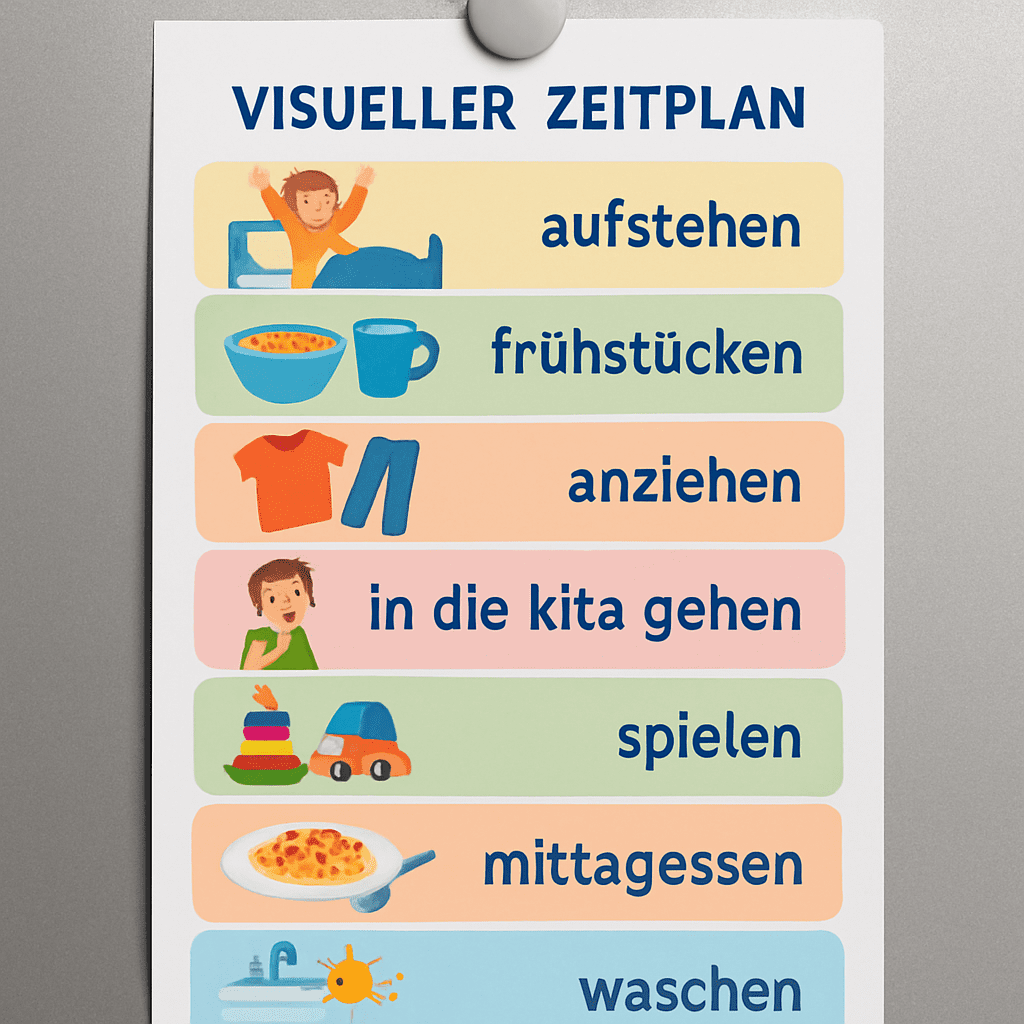
- Create a visual schedule for children: Since toddlers can't read clocks, pictures help. A laminated chart with photos (getting up, brushing teeth, getting dressed, going out) where the child can check off what's done with a Velcro star works wonders. It gives the child structure and control.
This often reveals the area of tension Routine vs. Flexibility in Child-Rearing. While the routine should be fixed, flexibility is needed in its implementation. Whether the child brushes their teeth standing, sitting, or hopping on one foot can be handled flexibly as long as the goal is achieved.
Strategy 2: False Alternatives and the Magic of Genuine Participation
A toddler in the autonomy phase doesn't want to be controlled. Constant, condescending commands create resistance. If we Promoting Cooperation Instead of Resistance in Children we want to give them the feeling that they are in control (at least a little bit).
„Channeling DIY smartly
Many parents wonder: How do I respond to defiance during dressing periods? The answer often lies in redirecting the focus. Use Giving choices as a parenting method.
Don't offer: „Get dressed now!“ (This leads to „No!“). Instead, offer: „Would you like to wear the red sweater or the blue sweater today?“
The child must get dressed – this rule is set in stone. But the How may also have a say. Further examples of closed choices:
- „Should we stomp to the car like an elephant or sneak like a mouse?“
- „Would you like to put on the left or right shoe first?“
- „Should I zip up your jacket for you, or do you want to do it yourself?“
This way Promoting independence without losing time, since the child is not fighting you, but is busy with decision-making.
Teamwork through games and races
When time is extremely tight, it often helps to make a virtue out of necessity. Turn fulfilling your duty into a game.
- The race against the hourglass „Can we get our shoes on before the sand runs out?“
- Body Part Check: „Where does the hat go? On the foot? No? On the belly? Ah, on the head!“ Humor breaks down resistance almost always.
This playful approach removes the seriousness from the situation. The child doesn't cooperate because they „have to,“ but because it's fun.

Strategy 3: Embrace emotions when the plan fails
Despite the best preparation, despite fun games and choices, there will be days when everything goes wrong. The child throws themselves on the hallway floor screaming because the cookie is in the wrong hand or the wrong seam on the sock is scratching. And you have to catch the train in 10 minutes.
Breathe and accompany
The ultimate discipline for parents is to give a Emotional storm under time pressure to master. The moment a child's brain is flooded with emotions (the so-called „amygdala hijack“), your child is no longer reachable rationally. Arguments like „We'll be late otherwise!“ will have no effect.
Around the Toddler Autonomy Stage: Managing Time Pressure To be able to, you paradoxically need to slow down first:
- Stop Take a deep breath yourself. Your stress is transferred 1:1 to the child.
- Connection before correction: Get down to their eye level. Signal: „I see that you are really angry/sad right now.“
- Physical contact Offer a hug (if the child allows it) or gently place your hand on their back.
It might take you two minutes to fully engage with this emotion. But if you try to forcefully stuff the screaming child into the jacket, the tantrum often lasts 20 minutes and the rest of the day is ruined for both sides.
The balance between empathy and leadership
Needs-based orientation doesn't mean that children can do whatever they want and that there are no more set schedules. Rather, it's about, Empathy and setting clear boundaries to combine.
When time is up, it's up. Then you have to act lovingly, but firmly. One sentence could be: „I know you really wanted to put on your shoes yourself. That didn't work out today, and that makes you angry. I understand that. But we have to go now, so I'm going to help you with it.“
The child is allowed to be angry about the circumstances (empathy), but the action will still be carried out (clear boundary). Accompany the tears on the way to the car or train. It is completely okay for the child to express their frustration about not getting their way. You are the safe harbor that can withstand this frustration while simultaneously taking on parental leadership and ensuring the family schedule is maintained.

Conclusion: A dance between independence and time
There's no magic remote control to get toddlers dressed and marching obediently out the door at the push of a button. The constant friction between parental time pressure and a child's drive for self-determination is exhausting – but it's also a sign that your child is growing up healthy.
If you refer to the 3 Strategies When Toddler Autonomy Clashes With Parent Schedules support, the morning hours become noticeably more harmonious:
- Create time buffers in the evenings and use visual aids for smooth transitions.
- Hand over small parts of control to your child through closed choices to resolve resistance.
- Stay calm when things get loud. Empathy paired with loving parental guidance will get you there faster than scolding.
On the most stressful days, always remember one thing: it’s „just“ a phase. Eventually, your child will tie their shoes in seconds, zip up their jacket, and be at the door on time. Until then, take a deep breath, laugh about the wrong shoe on the right foot, and celebrate the small victories of autonomy.