
Imagine your child building a tower out of blocks. It collapses, and those little hands immediately start over. In this simple moment, much more is happening in their mind than just play – it's applied early childhood education. We all want our children to be able to face future challenges masters with confidence. However, for this, we do not need to build academic pressure, but merely lay a solid cognitive foundation.
According to developmental researchers, the child's brain during these years is like a dense forest. Each new attempt carves a tiny path through the undergrowth. The more often a skill is practiced, the more likely this narrow path is to become a sturdy road. Experts call this enormous adaptability neuroplasticity. When we promote cognitive development – with infancy and preschool age being particularly formative – it's precisely about establishing useful and stable connections in the mind.
However, the most important fertilizer for this growth is not expensive learning toys, but genuine connection. Only those who feel secure can learn without stress and develop robust mental health. This human aspect of brain development can be strengthened in everyday family life.
Why haptic gaming beats digital media and makes the brain ‚tangible‘
When a child swipes across a smooth screen, it lights up and flashes, but a crucial ingredient for brain development is missing: grasping, to „comprehend“ the world in the truest sense of the word. When directly comparing digital media and haptic gaming the tangible world always wins. The reason for this is so-called sensory integration – the brain's important ability to meaningfully link different sensory impressions. Every firm pressure or rough object provides the brain with direct, tangible feedback (haptic feedback) that screens simply cannot offer.
Surprisingly, this very movement of the hands is closely related to speech. When small fingers feel or sort, the same brain regions that are crucial for language development later on are activated. Fine motor skills essentially lay the foundation for vocabulary. Therefore, when equipping a nursery, the principle of „less is more“ applies. Often, it is true that: The best learning toys for cognitive skills They don't have to be expensive or flashy; we find them quite naturally in our own homes.
The kitchen, in particular, often transforms into the perfect training ground for little explorers. Here, you can effortlessly turn everyday moments into valuable learning opportunities:
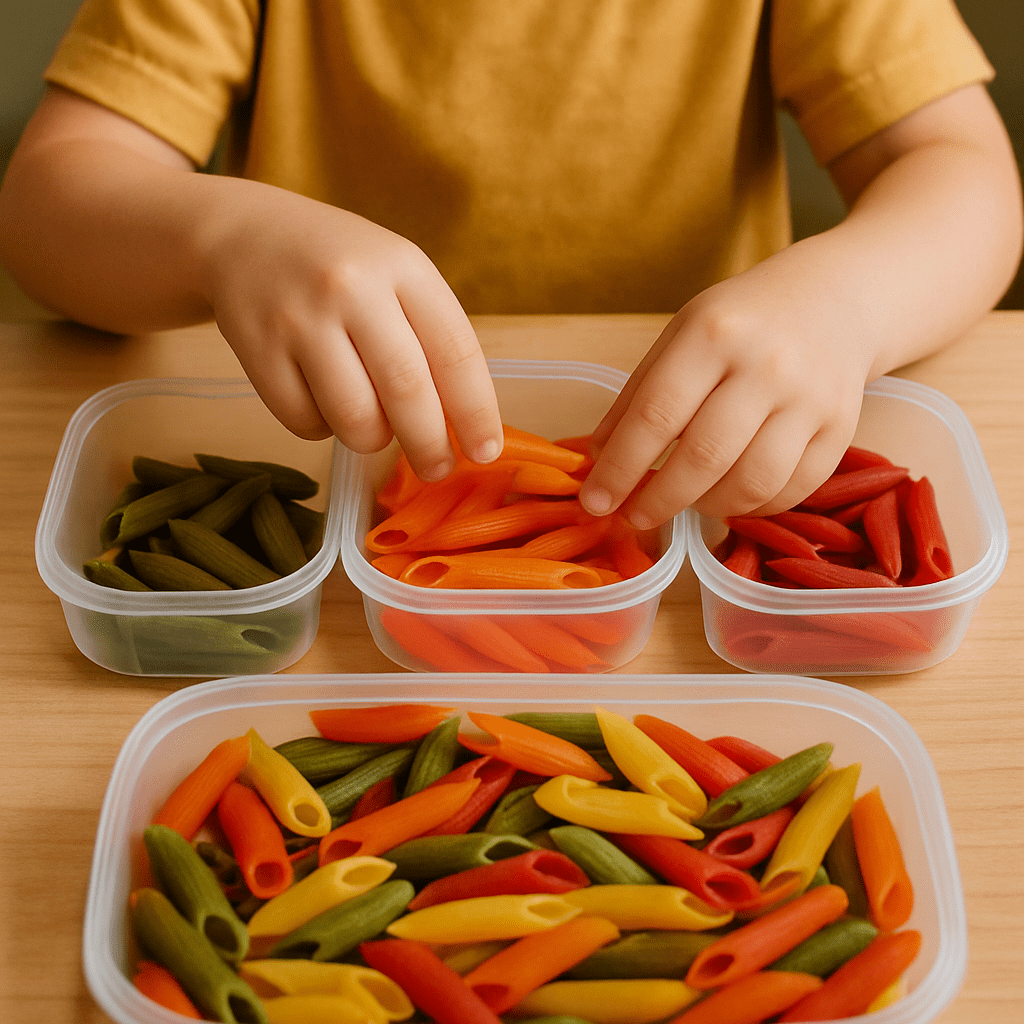
- Sort colored pasta: Dividing different shapes into bowls promotes precise pincer grasp.
- Work with dough or clay The firm pressing and kneading strengthens the hand muscles and calms the nervous system.
- Button treasure chest: Grasping different sizes and textures trains the fine perception of the fingertips.
Every time your child tries to pick up a tiny noodle, they are training more than just their fingers. They are practicing perseverance and overcoming initial frustration when something doesn't work right away. It is precisely this perseverance that trains the ability to control impulses and focus.
The ‚Air Traffic Controllers‘ in Your Head: How to Train Concentration and Self-Control in Everyday Life
Have you ever watched your child reach for a cookie, only to suddenly stop mid-motion? In this seemingly small moment, the brain is working overtime. This is thanks to executive functions – essentially the „air traffic controllers“ in your child's head. They coordinate incoming information, direct attention, and help regulate initial impulses. When we specifically target Promote executive functions in everyday life, we give our children the most important tool for an independent and focused life.
Long-term studies have shown something astonishing: the ability to exercise self-control is often more decisive for later life than a high IQ. Experts call this ability „inhibitory control“ - which simply means the inner brake that prevents us from immediately shouting out in anger or giving up at the first difficulty. Fortunately, this mental brake is not an innate talent, but a muscle that grows steadily during childhood play.
You don't need expensive programs for that. The best Concentration exercises for at home we usually still know from our own youth. The following games train self-control incidentally and can also be wonderfully used as Memory training for older children suitable:
- Stop dance Anyone who freezes instantly when the music stops is playfully practicing the abrupt braking of physical impulses.
- I'm packing my suitcase: This absolute classic challenges the inner notepad – the working memory – to perform at peak level.
- Classic Board Games Waiting patiently until it's finally your turn is the ultimate training for frustration tolerance.
- Simon Says Listening carefully and reacting only to specific signals sharpens focused attention enormously.
These playful challenges properly strain the child's management system. But even the best air traffic controller makes mistakes when they simply lack energy. For these complex thought processes to run smoothly, a solid physical foundation is also essential.
Fuel for the Thinker: Why Sleep and Omega-3s Form the Brain's Hardware
After a day full of new rules and countless impressions, the brain certainly doesn't shut down in the evening, but begins its most important phase.
During dreaming, the mind literally tidies up. Science calls this process sleep consolidation - think of it like an inner librarian sorting through the experiences of the day and storing important things permanently. This enormous The Influence of Sleep on Learning Performance shows that children only consolidate new knowledge in deep sleep, when the experiences are sorted and the mental garbage is disposed of.
In addition to nighttime recovery, this biological hardware also requires excellent building materials during the day. Considering the Effect of Omega-3 Fatty Acids on the Child's Brain, so special DHA and EPA fatty acids are particularly in focus. Think of these healthy fats as a type of insulating tape for delicate nerve pathways: the better these mental cables are protected, the faster and more error-free thoughts flow.
We can easily support this setup by incorporating walnuts, flaxseed oil, or fatty fish into the family's meal plan. A solid foundation of nightly brain maintenance and brain-friendly nutrition noticeably reduces our children's cognitive fatigue. When the physical hardware runs smoothly, the little ones have much more energy to overcome mental hurdles on their own.
The Secret of Self-Efficacy: How Frustration is Transformed into Logical Thinking
Trying to stuff too big a pillow into a small basket is sheer hard labor for little hands. Why exercise is so important for the brain, The meaning becomes clear here: understanding literally comes from grasping. When children overcome physical obstacles, they train their spatial reasoning – the internal logic for how things fit together in the world.
It is precisely on the threshold between the first failure and the next attempt that inner conviction grows that challenges can be overcome through one's own strength. Experts call this mental strength self-efficacy. In order to Building self-efficacy in children, we have to allow them space for some productive frustration. If we don't intervene immediately, they'll learn to break a problem down into small, manageable steps. When asked, how children learn logical thinking, is therefore the simplest answer: By letting them discover the solution path through their own trial and error.
Instead of immediately solving the problem themselves, parents can act as verbal guardrails. When frustration boils over, three simple sentences help reprogram the mind to seek solutions:
- „What have you tried so far?“
- „Let's look at the plan again in detail.“
- „I'm here if you need a tip.“
Every small, everyday problem, no matter how minor, that you solve on your own, sustainably strengthens your belief in your own abilities. This hard-earned perseverance helps not only in building forts but also in handling complex emotions—a skill that is further deepened through shared stories.
Resilience through Reading Aloud: How Stories Anchor Emotional Intelligence and Vocabulary
Shared cuddle minutes with a picture book on the sofa are far more than just a nice bedtime ritual. This form of early childhood education through reading aloud lays the foundation for all future thinking. Reading together expands your child's inner vocabulary. Those who know many words for their inner world can sort out and grasp situations much better mentally.
When we don't just read aloud, but actively talk about the story with the child, the true magic unfolds. Experts call this exchange dialogic reading. We use the characters in the book to explore conflicts safely. Simple questions like „Why do you think the little bear is crying now?“ are excellent in everyday life. Exercises to strengthen resilience in children. This is how young people train their emotional intelligence – the invaluable ability to accurately recognize and manage their own and others' feelings.
At the same time, the physical closeness during the story acts like an invisible shield. This intimate moment of connection creates an enormous Stress relief. The brain needs exactly this deep emotional security in order to open up and network at all. From this safe harbor, children are much more likely to dare to make mistakes and try new things the next day.
Every page read together thus creates a strong network, which makes curiosity and a willingness to take risks possible when learning.
Your roadmap for a smart everyday life: Small steps with a big impact
To sustainably foster cognitive abilities, we don't need expensive learning programs. It's the everyday moments that count. When we guide with mindfulness, a wonderful compound effect takes hold: Every small, seemingly unimportant experience shapes a strong, resilient foundation in the brain over the years.
Focus on consistency rather than perfection. Even small daily routines are enough to strengthen mental abilities in passing:
- Incorporate a haptic task into everyday life (e.g., kneading dough while baking).
- Use a focus game to bridge waiting times.
- Read an additional book together in the evening.
- Incorporate a serving of real „brain food“ into your diet.
- Give the child time to solve a problem completely on their own.
We ourselves are the most influential environment for our children. Move forward with shared curiosity and observe how much power lies in these simple routines. Today's playful discoverers will naturally become tomorrow's resilient, confident thinkers.